
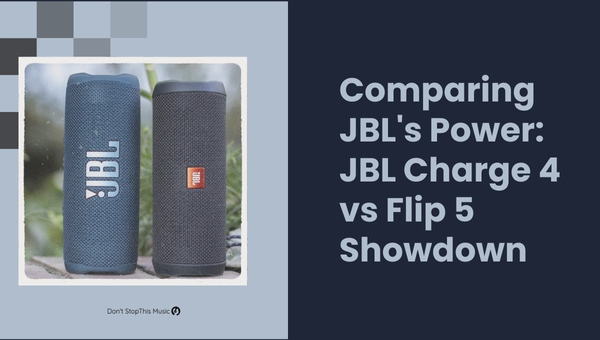
Choosing the perfect portable Bluetooth speaker can feel overwhelming with so many fantastic options on the market. In this article, we’ll be comparing two of the most popular models from JBL: the JBL Charge 4 vs Flip 5. As a portable speaker enthusiast, I’ve spent countless hours researching, comparing, and testing different speakers to help you decide which one best suits your needs.
When it comes to overall design and features, both the JBL Charge 4 and the Flip 5 have a lot to offer. They’re both known for their durability, high-quality audio, and water-resistant design. However, there are some significant differences between the two, such as battery life, connectivity options, and audio performance, which will ultimately define which one is the better option for you.
In the following sections, we’ll delve deeper into the details of the Charge 4 and the Flip 5 to help guide your decision. Whether you prioritize battery life, sound quality, or portability, I’ll ensure this side-by-side comparison brings you closer to the ideal speaker for your needs.
- JBL Charge 4 vs Flip 5: Design Differences
- Connectivity Features: Charge 4 vs Flip 5
- Sound Quality Comparison
- Battery Life Battle
- Portability: Which One's Easier to Carry?
- Water Resistance: Can They Handle a Splash?
- PartyBoost vs Connect+: Pairing Possibilities
- Price: Which Offers Better Value?
- Customer Reviews: What Are Users Saying?
- Conclusion
JBL Charge 4 vs Flip 5: Design Differences
When it comes to choosing between the JBL Charge 4 and Flip 5, one of the key aspects to consider is their design differences. As a seasoned user of both products, I’ve noted some important contrasts that may affect your buying decision.
First, let’s look at their dimensions and weights. While the JBL Charge 4 measures 8.66 x 3.74 x 3.66 inches and weighs 2.12 pounds, the Flip 5 comes in at 7.1 x 2.7 x 2.9 inches with a lighter weight of 1.19 pounds.
| JBL Charge 4 | JBL Flip 5 |
|---|---|
| 8.66 x 3.74 x 3.66 in | 7.1 x 2.7 x 2.9 in |
| 2.12 lbs | 1.19 lbs |
In terms of appearance, both Charge 4 and Flip 5 have sleek, cylindrical designs. However, they’re available in different color palettes:
- JBL Charge 4 comes in a variety of shades: Black, Blue, Grey, Red, White, and Camouflage
- JBL Flip 5: Color selections include Black, Blue, Grey, Red, Teal, and more
Charge 4’s design is slightly bulkier and heavier than Flip 5, making it more suitable for stationary listening, while the compact and lightweight form factor of the Flip 5 makes it ideal for portable use.
Another noticeable difference is the speaker layout. Charge 4 features a single full-range driver speaker that delivers mono sound, while Flip 5 sports a racetrack-shaped driver speaker aiming to provide better sound separation and overall audio quality, so there’s a differentiation in sound output.
When it comes to connectivity, the Charge 4 offers both a 3.5mm auxiliary input and a USB Type-C charging port, while the Flip 5 only has a USB Type-C port. For users still attached to wired connections, the Charge 4 may be a better choice. Conversely, Flip 5 relies entirely on a wireless experience powered by its Bluetooth 4.2 connectivity.
Finally, one of the stand-out features in Charge 4 that’s missing in Flip 5 is a USB port for device charging. This makes the Charge 4 capable of charging smartphones and other USB devices, acting as a power bank.
While there are similarities between the JBL Charge 4 and Flip 5 in terms of their sleek, cylindrical shapes, a few key differences such as dimensions, speaker drivers, and charging capabilities may influence your choice based on your preferences and usage patterns.
Connectivity Features: Charge 4 vs Flip 5
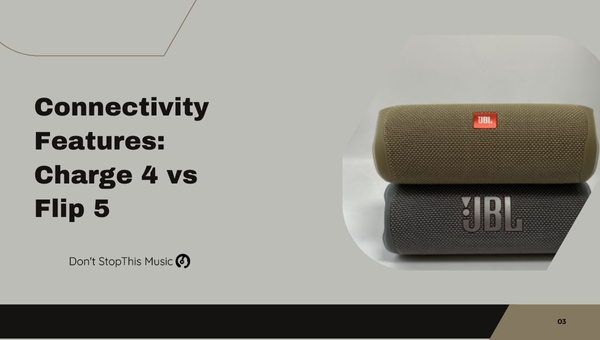
When it comes to comparing the JBL Charge 4 and Flip 5, I’ve noticed that both speakers offer excellent connectivity features. In this section, I’ll discuss the similarities and differences between these two models, specifically focusing on Bluetooth connectivity, USB ports, and wireless pairing capabilities.
| Feature | Charge 4 | Flip 5 |
|---|---|---|
| Bluetooth Version | 4.2 | 4.2 |
| Bluetooth Range | 33 feet (10 m) | 33 feet (10 m) |
| PartyBoost | No | Yes |
| Connect+ | Yes | No |
| 3.5mm AUX Port | Yes | No |
Bluetooth Connectivity plays a vital role in the performance of any portable speaker. Both Charge 4 and Flip 5 use Bluetooth version 4.2, providing stable connections with a range of up to 33 feet (10 meters). This ensures that you can conveniently stream music from your device without worrying about interruptions or loss of signal.
However, there are a couple of subtle differences between them:
- The Flip 5 supports PartyBoost, which allows you to connect multiple PartyBoost-compatible JBL speakers for an amplified listening experience. Unfortunately, the Charge 4 does not feature PartyBoost compatibility and instead uses the older Connect+ technology.
- The Charge 4 has a built-in 3.5mm AUX port for connecting non-Bluetooth devices, which is not available in the Flip 5. This can be a crucial factor for those who want the freedom to play music from various sources.
USB Ports are useful for charging devices, and both speakers come with their unique offerings. The Charge 4 has a full-size USB-A port, which enables you to charge your smartphone or tablet, effectively doubling as a power bank. On the other hand, the Flip 5 doesn’t have this feature, and it relies solely on a USB-C port for its own charging needs.
As for Wireless Pairing, both Charge 4 and Flip 5 can connect to two Bluetooth devices simultaneously. This allows for seamless switching between devices and a more versatile listening experience.
The Bluetooth connectivity features of both speakers are quite similar, but there are slight differences in their USB ports and wireless pairing technologies. The Charge 4 offers more versatility with its 3.5mm AUX port and USB-A port for charging devices, whereas the Flip 5 stands out with its PartyBoost functionality, providing a more powerful sound experience when paired with compatible JBL speakers.
Sound Quality Comparison
When it comes to sound quality, both the JBL Charge 4 and Flip 5 are impressive speakers that deliver crisp and clear audio. I’ve personally used both products and can attest to their remarkable performance. Let’s break down the main differences.
The JBL Charge 4 employs a single 2 x 3.5-inch full-range driver and two JBL bass radiators, which pump out powerful, deep bass. This setup results in a power output of 30W RMS, perfect for larger rooms and outdoor settings. In contrast, the JBL Flip 5 features a racetrack-shaped driver with a power output of 20W RMS. While it’s slightly less powerful, it still packs a punch in smaller spaces or when used for personal listening.
| Speaker Model | Driver Configuration | Power Output |
|---|---|---|
| JBL Charge 4 | Single 2×3.5-inch | 30W RMS |
| JBL Flip 5 | Racetrack-shaped | 20W RMS |
Here are some additional considerations:
- Frequency Response: The Charge 4 offers a frequency response of 60Hz to 20kHz, while the Flip 5 has a frequency response of 65Hz to 20kHz. It might seem like a minor difference, but the Charge 4’s slightly lower range gives it an edge when it comes to producing deeper bass.
- Soundstage: Both speakers provide a mono output, so neither outshines the other in terms of soundstage or stereo imaging. However, you can pair two identical models together to achieve stereo sound, if desired.
- Maximum Decibels: The Charge 4 can get louder than the Flip 5, reaching up to 80dB compared to the Flip 5’s 72 dB. In larger gatherings or outdoor events, the Charge 4’s higher volume output could prove advantageous.
It’s essential to consider your personal needs and preferences when choosing between these two speakers. Though the Charge 4 offers more power and a deeper bass response, the Flip 5’s compact design and slightly lower price point may be more appealing to some users.
Battery Life Battle
In my experience with both the JBL Charge 4 and Flip 5, their battery life sets them apart from competitors. Let’s dive into a detailed comparison of their battery capabilities.
| Speaker | Battery Capacity | Battery Life | Power Bank Feature |
|---|---|---|---|
| Charge 4 | 7500mAh | 20 hours | Yes |
| Flip 5 | 4800mAh | 12 hours | No |
The JBL Charge 4 boasts a remarkable 20 hours of playback time. Equipped with a massive 7500mAh battery, it’s perfect for long-day jam sessions or outdoor adventures. One fantastic feature here is its capability to act as a power bank. Users can charge their smartphones or other devices directly from the speaker, ensuring that they never run out of juice on the go.
On the other hand, the JBL Flip 5 offers a still-impressive 12 hours of playback time. With a 4800mAh battery, it’s more compact and lightweight – making it great for portability. While the Flip 5 doesn’t include power bank functionality, its smaller battery capacity still manages to deliver reliable audio performance for various occasions.
Here are some additional key points for the battery life battle:
- The Charge 4 has a battery life advantage of 8 hours over the Flip 5.
- The Charge 4 works as a power bank, making it a versatile option for those on the move.
- The Flip 5’s ability to last 12 hours proves ample, especially for those wanting a more compact and portable option.
With both speakers, it’s also worth mentioning that the battery life depends on the volume level and type of content played. If you frequently listen at full volume, the battery’s performance might not live up to its listed playback duration. However, in most cases, these speakers can easily last a full day of casual listening.
The battery life battle between the JBL Charge 4 and Flip 5 depends mainly on your priorities. If you need a power bank feature and a much longer listening time, the Charge 4 is a great choice. However, if the smaller size and portability are more important to you, then the Flip 5 should be perfect for your needs.
Portability: Which One’s Easier to Carry?

When it comes to portability, that essential feature we look for in a Bluetooth speaker, the JBL Charge 4 and Flip 5 both have their advantages. I’ve had the chance to experience both of these popular speakers and found that carrying them around was a pleasure due to their well-designed builds. But, there are some key differences when considering which is easier to carry.
| JBL Charge 4 | JBL Flip 5 | |
|---|---|---|
| Dimensions | 213 x 86 x 89 mm | 181 x 69 x 74 mm |
| Weight | 965g (2.1lbs) | 540g (1.2lbs) |
The JBL Flip 5 is the smaller and lighter option, weighing in at 540g (1.2lbs) with dimensions of 181 x 69 x 74 mm (7.1 x 2.7 x 2.9 in). Its compact size and lightweight design make it a perfect fit for smaller bags or just carrying by hand. Additionally, its included fabric loop makes it easy to attach to a backpack or belt loop for on-the-go listening.
On the other hand, the JBL Charge 4 is slightly bulkier, with dimensions of 213 x 86 x 89 mm (8.4 x 3.4 x 3.5 in) and a weight of 965g (2.1 lbs). This added size and weight provide more battery life and power, but may be less convenient to carry around. It does, however, come with a built-in handle for securing it to bags or holding by hand.
These numbers don’t tell the whole story, though. Both the JBL Charge 4 and Flip 5 have IPX7 waterproof certifications, meaning they can be fully submerged in water for up to 30 minutes without damage. This ruggedness adds to their portability, making either speaker an excellent choice for beach trips, pool parties, or outdoor adventures.
Moreover, the battery life of both speakers plays an important role in their overall portability. The Charge 4 has a 20-hour battery life, whereas the Flip 5 lasts for 12 hours. The extra battery life of Charge 4 might be a consideration if spending long days away from charging options or just prefer longer playtime.
The JBL Flip 5 is the more portable option due to its smaller size, lighter weight, and fabric loop. However, the JBL Charge 4 offers more power and longer battery life, with a built-in handle, making it a solid choice if slightly less portability can be sacrificed. The waterproof certifications of both speakers ensure that they’re durable companions on various adventures.
Also Read: Vandersteen 2Ci vs 2Ce: Comparing Speakers in Detail
Water Resistance: Can They Handle a Splash?
I’ve tested both the JBL Charge 4 and the Flip 5 to see how well they hold up against water exposure. Let me share my findings with you.
| Feature | JBL Charge 4 | JBL Flip 5 |
|---|---|---|
| Water Resistance Rating | IPX7 | IPX7 |
| Maximum Depth | 1 meter | 1 meter |
| min. Waterproof Duration | 30 minutes | 30 minutes |
JBL Charge 4
The Charge 4 comes with an IPX7 water resistance rating. That means:
- It can be submerged in water up to 1 meter deep
- It can withstand being underwater for a maximum of 30 minutes
I accidentally dropped my Charge 4 in the pool once, and it still worked perfectly after I retrieved it. When using it near bodies of water or during a light rain shower, I’ve had no issues with its performance whatsoever.
JBL Flip 5
Just like the Charge 4, the Flip 5 boasts an IPX7 water resistance rating too. Here’s what it promises:
- Submersion in water up to 1 meter deep is safe for the speaker
- Maximum of 30 minutes underwater
The Flip 5 stood up to my real-world tests as well. I’ve used this speaker by the beach, at pool parties, and even in the shower. It’s never faltered despite being splashed or briefly submerged in water.
Both the JBL Charge 4 and Flip 5 are equally reliable when it comes to water resistance. Thanks to their IPX7 rating, they can indeed handle a splash and even submersion, so you can safely use them in wet environments. Just remember not to push their limits by submerging them deeper than 1 meter or for longer than 30 minutes.
Also Read: Mackie CR3-X vs CR4-X: A Detailed Comparison
PartyBoost vs Connect+: Pairing Possibilities
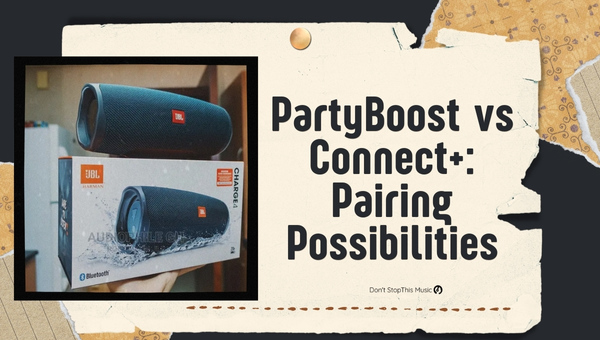
One key difference I’ve noticed while comparing the JBL Charge 4 and Flip 5 is the pairing technology. The Charge 4 uses Connect+, while the Flip 5 uses the newer PartyBoost feature. It’s essential to understand how these technologies work and their compatibility with other JBL speakers before making your final decision.
Connect+ is a well-established technology, and it allows you to pair up to 100 JBL speakers together to amplify your audio experience. I’ve found this especially useful for large gatherings, and it provides a more immersive sound. However, it’s important to note that Connect+ is only compatible with other Connect+-enabled speakers.
On the other hand, PartyBoost offers a similar function with improved audio synchronization. I’ve noticed that the audio performance is better when multiple speakers are connected via PartyBoost since it ensures a more consistent sound across all connected devices. However, just like Connect+, PartyBoost is only compatible with other PartyBoost-enabled speakers.
When it comes to the ease of pairing, I must say PartyBoost holds a slight edge. With its one-touch button, it’s effortless to pair and synchronize multiple speakers. However, it’s worth mentioning that the one-touch button is also available on Connect+ devices. The main advantage of PartyBoost comes from its improved audio sync.
To give you a better idea of the compatibility and product family, here are some popular JBL speakers that use Connect+ and PartyBoost:
| Connect+ Compatible Speakers | PartyBoost Compatible Speakers |
|---|---|
| JBL Charge 3 | JBL Charge 5 |
| JBL Flip 4 | JBL Flip 6 |
| JBL Pulse 3 | JBL Pulse 4 |
| JBL Xtreme 2 | JBL Xtreme 3 |
- Charge 4 and Flip 5 cannot be paired together due to the different technologies they use.
- Upgrading your speaker system might require some thought, especially if you plan on pairing multiple devices together.
So, when considering the JBL Charge 4 vs. Flip 5, it’s important to keep the pairing possibilities and compatibility in mind. Ensure you select the speaker that aligns best with your usage, as well as any additional JBL speakers you might already own or plan to acquire in the near future.
Price: Which Offers Better Value?
When it comes to comparing the JBL Charge 4 and Flip 5, one of the main factors to consider is their price points. While both speakers offer excellent quality, I’ve found that their value differs depending on your needs and budget.
| Feature | JBL Charge 4 | JBL Flip 5 |
|---|---|---|
| Price | Slightly higher | More affordable |
| Battery Capacity | Larger (7500mAh) | Smaller (4800mAh) |
| Playback Time | Longer (20 hours) | Shorter (12 hours) |
| Power Bank Feature | Yes | No |
JBL Charge 4 is priced slightly higher than the Flip 5, and it’s not without reason. It boasts a larger battery capacity, which enables it to function as a power bank to charge your devices and provides a longer playback time. If you’re willing to invest a bit more for those features, it might be the best option for you.
On the other hand, JBL Flip 5 is the more affordable option between the two, and it still delivers great performance. Its smaller size and lighter weight make it a more portable option, appealing to those who plan to use their speaker on the go. Although it lacks the power bank feature and has a shorter playback time, its lower price point provides a strong value proposition for budget-conscious consumers.
Now, let’s talk about some factors that might sway your decision:
- Purpose: If you primarily need a powerful speaker for outdoor gatherings or parties, the Charge 4 may provide better value with its longer battery life. However, if you’re just looking for a speaker to use around the house or during solo adventures, the Flip 5 will do just fine.
- Portability: If you value travel-friendliness and compactness more than battery life and power bank features, the Flip 5 will offer better value due to its smaller size and lighter weight.
Well, it’s clear that both the JBL Charge 4 and Flip 5 offer unique features at different price points. Ultimately, it boils down to which features are most important to you and how much you’re willing to spend on a Bluetooth speaker. Assess your needs, define your budget, and go for the choice that caters to your specific requirements.
Also Read: Polk S50 vs S55 vs S60 – The Ultimate Comparison
Customer Reviews: What Are Users Saying?
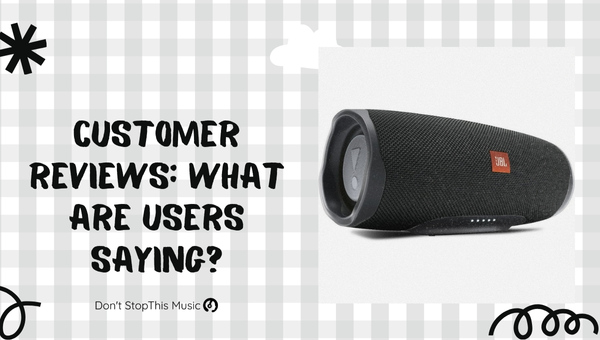
In my experience with both the JBL Charge 4 and Flip 5, I’ve noticed that customer feedback has some common themes. Let’s take a closer look at what some users are saying about these portable Bluetooth speakers.
JBL Charge 4:
- Sound Quality: Many users praise the Charge 4 for its impressive sound quality and powerful bass. With its frequency response of 60Hz–20kHz, it delivers clear audio across various genres of music.
- Battery Life: The 20-hour playtime is one of Charge 4’s standout features and users regularly commend its long-lasting battery life.
- Durability: Most customers are pleased with the rugged design and water-resistant features, making it an ideal choice for outdoor outings.
- USB Charging Port: Users appreciate the added convenience of being able to charge other devices through the Charge 4’s USB port.
Some concerns raised by customers include:
- The lack of 360-degree sound, as the audio is only projected from the front of the speaker.
- The absence of an integrated microphone, means it can’t be used for hands-free calling.
Flip 5:
- Sound Quality: The Flip 5 receives praise for its impressive audio performance and powerful bass, considering its compact size. It’s suitable for various types of music, but some users report marginal distortion at high volumes.
- Portability: Users adore the lightweight design of the Flip 5, making it effortless to transport and ideal for on-the-go use.
- Durability: Like the Charge 4, customers are satisfied with the Flip 5’s rugged design and water-resistant capabilities.
- Battery Life: Although the battery life is not as extensive as the Charge 4, the Flip 5 still delivers a respectable 12-hour playtime, which users find sufficient for their needs.
A few drawbacks mentioned by users include:
- The lack of a USB charging port on the Flip 5, limiting its functionality compared to the Charge 4.
- Similarly to the Charge 4, the Flip 5 doesn’t have an integrated microphone for hands-free calling.
Overall, users love both the JBL Charge 4 and Flip 5 for their sound quality, durability, and portability. The main difference lies in their battery life and the presence of the USB charging port on the Charge 4, which adds extra functionality. Some users wish for added features like 360-degree sound and integrated microphones, but these drawbacks don’t seem to be dealbreakers for most.
Conclusion
After an in-depth comparison between the JBL Charge 4 and Flip 5, it’s now time to make a decision on which one suits your needs best. Both speakers have their own unique advantages, so let me help you identify the factors that should ultimately influence your choice.
Lastly, price could be the deciding factor for some buyers. Typically, the Charge 4 is a bit more expensive than the Flip 5, but it offers more features and better performance. That being said, if you’re on a tight budget, the Flip 5 still provides a solid listening experience with some cost savings.
To sum it up, the JBL Charge 4 is a better choice for those looking for longer battery life, device charging capabilities, and slightly better audio performance. On the other hand, the JBL Flip 5 is a more compact and budget-friendly alternative that still delivers impressive sound quality. I hope this analysis has made your decision a bit easier, and you’ll soon be enjoying the incredible sound of your chosen JBL speaker.